A practical understanding of yacht charter insurance in New York starts with the policy’s scope: yacht insurance is generally designed for privately owned recreational vessels over 26 feet, while charter use can bring additional underwriting questions. New York has no blanket legal requirement for boat owners to carry insurance, but coverage can help address vessel damage and liability for injury or damage to others.
It’s natural to focus on the yacht itself, but how it will be used matters just as much. This guide explains common policy protections, how insurers assess charter frequency, destinations, and crew arrangements, and how a yacht’s valuation method can affect a claim payout.
You’ll also learn what can influence boat insurance costs, without mistaking a general estimate for a quote on a specific yacht. These essentials can help you understand the insurance questions involved in chartering and plan time on New York’s coastal waters with clearer expectations.
Key Takeaways
- Understand how coverage for navigation equipment, crew, and personal effects can shape a yacht policy’s scope and cost.
- Learn how exclusions, deductibles, and navigation limits affect the protection a policy provides.
- See which details of a charter’s frequency, destinations, and crew arrangements insurers may consider.
- Compare agreed amount and actual cash value policies to understand how vessel valuation can influence a claim payout.
How Much is Boat Insurance?
Boat insurance costs depend on the yacht’s insured value, coverage, and use.
Equipment, Crew, and Personal Effects Coverage
Coverage may include navigation equipment, crew-related exposures, and personal effects aboard. For a luxury yacht, these items present distinct risks beyond physical damage to the hull.
Owners may need additional protection for navigation equipment, crew, and passengers’ belongings. Policy terms determine which items and losses qualify, so review these details when assessing the yacht’s insured value and overall premium.
Liability and Physical Damage Protection
Liability coverage can protect an owner against claims for injury or damage to others, while physical damage coverage can protect the vessel after an accident. Yacht protection and indemnity, or P&I, insurance can cover judgments against the insured and defense costs in admiralty courts.
For offshore sailing, the P&I liability terms and the policy’s navigation territory matter. Coverage is subject to the limits and conditions written into the policy. Larger vessels may also need to consider environmental liability and property damage coverage.
Charter and Private Yacht Insurance Differences
Charter insurance accounts for commercial charter activity, while private yacht insurance is designed for personal recreational use. Yacht insurance is typically designed for privately owned recreational vessels over 26 feet; pleasure boat coverage addresses other recreational craft.
Because chartering changes how a yacht is used, insurers may ask about charter frequency, destinations, and crew arrangements. To obtain a quote, provide these operating details along with information about the yacht. They help insurers assess the risk and price the coverage.
Passenger, Crew, Pollution, and Property Coverage
Charter insurance may address passenger and crew liability, pollution exposure, and property damage, subject to the policy’s coverage and exclusions. P&I can cover judgments and legal defense, while physical damage coverage applies to the insured vessel, not automatically to every person or item aboard.
New York boat owners may also obtain personal-property coverage, towing assistance, and uninsured-boater protection. Review each category separately, including coverage for navigation equipment and personal effects, to understand what the policy actually protects.
What is Yacht Insurance?
Yacht insurance is designed typically for privately owned recreational vessels over 26 feet. For boating and charter use, exclusions, deductibles, and navigation limits shape what an insurance policy protects.
Policy Exclusions, Deductibles, and Navigation Limits
Exclusions identify losses a policy doesn’t cover, while deductibles set the amount the policyholder pays toward a covered claim. Both affect the financial protection available after a loss.
Yacht insurance generally excludes wear and tear, gradual deterioration, marine life damage, manufacturer’s defects, and design defects. A 1% deductible on a $100,000 yacht means the policyholder pays $1,000 before coverage begins.
Deductibles can affect the overall cost of yacht insurance, so compare options when reviewing a quote. Navigation limits also define where a vessel can travel under the policy. One policy required the boat to leave the hurricane zone by June 1, so negotiating navigation terms matters for planned routes.
For a luxury yacht, discuss the operating area, equipment, and crew arrangements when reviewing policy terms. Coverage should reflect the yacht’s intended use rather than rely on a general boating policy.
New York Yacht Charter Coverage
In New York, yacht charter insurance can combine vessel protection and liability coverage, with policy terms setting the covered losses and limits. Charter use matters: the policy should reflect that the yacht carries paying guests, rather than being used only for private recreation.
Coverage varies by policy, including its exclusions and navigation boundaries. A charter operating within a defined New York area has different route details from one planning offshore sailing, so the stated territory should match the intended use.
Review boat insurance each year, especially when routes, charter activity, or equipment change. An updated route plan can prompt a review of navigation limits, while changes to crew arrangements may affect policy requirements. Regular reviews help keep coverage aligned with current operations.
Understanding yacht charter insurance in New York means considering the covered activity, deductible, and permitted navigation area together. Each term helps determine how the policy responds to a loss.
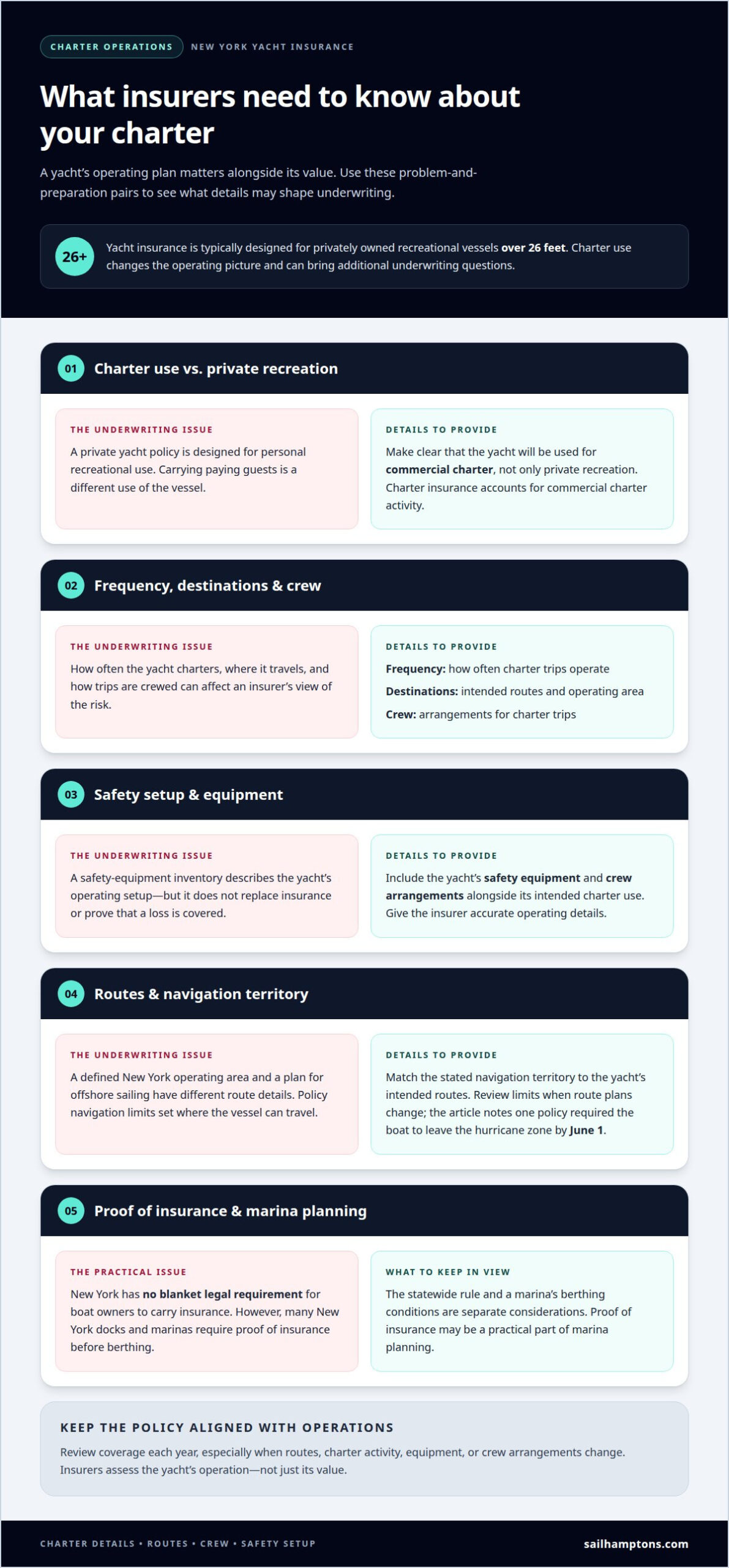
Charter operation details insurers may require
For charter insurance, insurers assess how the yacht will operate, not just its value. In New York, marina access and financing can also make proof of insurance relevant.
Safety Equipment and Insurance Requirements
Safety equipment describes a yacht’s operating setup, while insurance addresses financial risks. They serve different purposes, so an equipment inventory does not replace an insurance policy.
When preparing charter details, include the yacht’s safety equipment and crew arrangements alongside its intended use. Insurers may ask how trips will be crewed; accurate operating details help them assess the risk. A safety checklist is not proof of insurance coverage.
Marinas may set their own berthing conditions. Many New York docks and marinas require boat owners to provide proof of insurance before berthing, making the policy document a practical part of marina planning.
New York Charter Insurance Rules
New York has no blanket legal requirement for boat owners to carry boat insurance. That answers the general question, but charter arrangements and other operating conditions still matter.
For passenger-for-hire vessels, distinguish the statewide insurance rule from insurers’ questions about commercial use. Charter insurers may ask about frequency, destinations, and crew arrangements. These questions help describe the operation; they do not establish a separate legal insurance mandate.
Financing can create another requirement: lenders often require boat insurance before extending a boat loan. Most yacht lenders allow a maximum deductible of 2% of the insured value, so owners financing a vessel should account for that limit when considering policy terms.
Premium and Eligibility Factors
Insurers assess a charter’s operating profile to evaluate premium and eligibility. Clearly describe charter frequency, destinations, and crew arrangements. Each detail explains how the yacht will be used and what exposures the policy must address.
Crew requirements can also shape underwriting. In one reported case, an underwriter required a four-person crew, and the applicants tried to negotiate based on their experience. The example shows why crew arrangements and operating experience belong in the discussion, rather than being treated as incidental details.
For a quote, organize the yacht’s information, operating plan, and crew details together. Include marina or lender requirements, such as proof of insurance or a deductible limit, so the proposed coverage can be considered against those conditions.
Agreed amount versus actual cash value
A yacht’s valuation method influences how much an insurer may pay after a covered loss. Agreed amount coverage pays up to a selected amount for a total loss; actual cash value reflects the yacht’s market value, considering its age, condition, and prior damage.
With an agreed amount policy, the insured and insurer set the vessel’s value in advance. One reported example involved an insurer agreeing to insure a vessel for $300,000 under this arrangement. That figure establishes the policy’s maximum total-loss payment, subject to its terms and applicable limits.
Actual cash value is based on the yacht’s market value when the loss occurs, rather than an amount selected earlier. Age, condition, and prior damage can affect that assessment. For example, two yachts of the same model and original price may have different current values if one has sustained damage or shows more deterioration.
The National Boat Owners Association uses 27 feet as the dividing line between pleasure boats and yachts. That classification doesn’t determine a vessel’s claim value: the policy’s valuation basis does. Owners should distinguish the insured amount from the yacht’s changing market value when considering which approach fits their financial plans.
Hull valuation is separate from optional protections. New York boat owners may obtain towing assistance and personal-property coverage, but these benefits aren’t the same as the hull’s agreed amount or actual cash value. Review them as separate policy provisions, alongside the deductible and covered-loss terms.
For a planned charter, understanding how the vessel’s value is treated can help frame the insurance questions behind a trip. To enjoy a tailored sailing experience on New York waters, explore private yacht charter options.
SailHamptons
SailHamptons offers private and public sailing experiences from Sag Harbor for guests ready to plan time on the water. Once you’ve considered how charter use, yacht value, and policy terms affect insurance, choose the outing that suits your group and occasion.
Options include Luna Private Charter, Cosmos Private Charter, Blue Sky Private Charter, and Public Sunset Sail. Each gives you a different way to enjoy the East End’s coastal setting, whether you’re seeking a private journey or a shared sail. The insurance details in this guide can help clarify the questions around coverage; SailHamptons is the next step for planning the sailing experience itself.
Contact SailHamptons to discuss your charter plans.
Make Your Next Sailing Plan
Understanding yacht charter insurance in New York can clarify what to consider about a yacht and its use. Insurance decisions belong to the policyholder and insurer; as a guest, your next step is choosing the kind of time on the water you want to enjoy.
SailHamptons offers Luna Private Charter, Cosmos Private Charter, and Public Sunset Sail from Sag Harbor. Whether you’re planning a private outing or a shared sunset sail, let the occasion and atmosphere guide your choice. Start by deciding what matters most, from a quiet coastal escape to a memorable gathering with your guests.
For questions about your sailing plans, contact SailHamptons. Set your sights on the water, and take the next step toward a day shaped around your time on the coast.
Frequently Asked Questions
What is Hull Insurance?
Hull insurance covers physical damage to the insured yacht, subject to policy terms. The valuation basis matters: some yacht policies may provide replacement-cost coverage for partial losses, while sails, canvas, batteries, outboards, and sometimes outdrives may be subject to depreciation. For example, damage to a sail may be valued differently from damage to the hull.
How much does yacht charter insurance cost in New York?
Yacht charter insurance costs depend on the yacht’s insured value, charter activity, navigation area, coverage selected, and deductible. A Sag Harbor charter with a defined local itinerary has different operating details from a yacht planning broader offshore travel. Insurers quote for the specific risk and policy terms, so a general boat-insurance estimate shouldn’t be treated as the price for a particular charter operation.
What liability limits are typical for New York yacht charter insurance?
There isn’t one liability limit that applies to every New York yacht charter policy. The policy documents state the applicable limit, while the yacht’s use, passenger activity, crew arrangements, and navigation area describe the insured exposure. Protection and indemnity coverage may address judgments and defense costs in admiralty courts. Read the limit alongside its exclusions and the specific liabilities covered.
What exclusions and risks should New York yacht charter operators know about?
Pay particular attention to exclusions for wear and tear, gradual deterioration, marine-life damage, manufacturer’s defects, and design defects. A mismatch between actual charter operations and the use described in the policy is another risk. For example, a route or crew arrangement that differs from the stated plan can raise coverage questions after a loss. Pollution and crew-related exposures also deserve review.
What documents and safety requirements do insurers require for a New York yacht charter?
Insurers may request details about charter frequency, destinations, and crew arrangements. Those questions alone don’t establish a universal document checklist. In practice, accurate yacht and operating information helps describe the risk. New York docks and marinas may require proof of insurance for berthing, while lenders often require a policy before extending a boat loan.
How do New York coastal and inland waters affect yacht charter insurance coverage?
The policy’s navigation territory determines which waters are covered, so the planned route matters. A Sag Harbor itinerary confined to nearby waters differs from one extending beyond the stated navigation area. Coastal or inland labels alone don’t establish coverage; the policy wording and declared operating area do. Route changes can affect whether a trip fits the insured navigation terms.