
A large schooner makes the wind feel tangible: it fills a spread of sails, draws the vessel forward, and gives the journey a steady, purposeful rhythm. To understand what it is like to sail on a large schooner, picture multiple masts and fore-and-aft sails working together, with the crew adjusting the sail plan as the breeze shifts.
It’s natural to imagine that a bigger vessel simply feels more imposing. Under sail, its scale brings a more layered experience: sails share the work, rigging moves overhead, and the wind shapes the pace and feel of the ride.
This guide explains how a schooner’s masts and sails are arranged, what its size means underway, and how wind affects the experience. You’ll come away with a clearer sense of what to expect on the water, whether you’re watching the crew work the rig or settling in to take in the coast.
Key Takeaways
- Learn how a schooner’s multiple masts and fore-and-aft sails work together, and why its divided sail plan shapes the feel of the voyage.
- Understand why a vessel’s size alone doesn’t tell you its passenger capacity; the specific boat and its configuration matter.
- Get a clearer picture of what can shape a schooner outing, from the crew’s work under sail to the rhythm of the day’s schedule.
- See when SailHamptons’ Public Sunset Sail may suit a relaxed evening on the water beneath the schooner’s sails.
Characteristics of schooners under sail
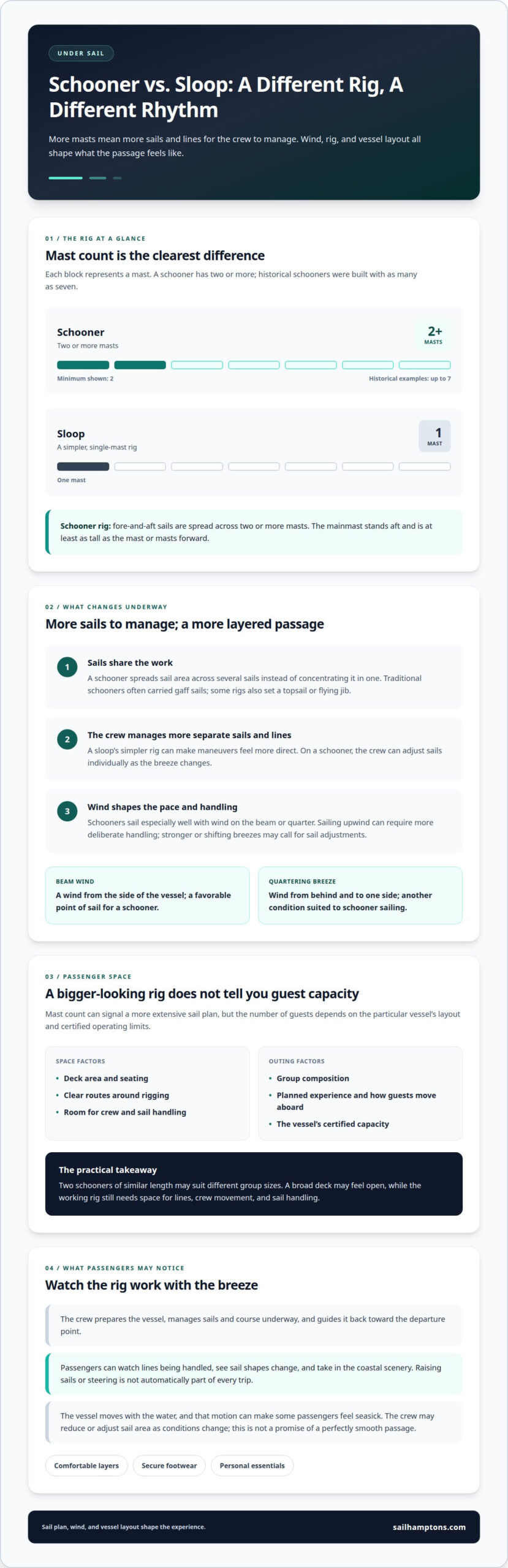
A schooner’s fore-and-aft sails are spread across two or more masts, creating a distinct profile underway. The mainmast stands aft and is at least as tall as the mast or masts forward.
Schooner Size and Passenger Capacity
A large schooner has a substantial hull and a multi-masted rig, but mast count alone doesn’t determine passenger capacity. The number of guests depends on the vessel’s layout and certified operating limits, so size is not a reliable guide to how many people can sail aboard.
Under sail, the divided plan spreads sail area across several sails rather than concentrating it in one. Traditional schooners often carried gaff sails, while some rigs also set a topsail or flying jib.
Schooners Compared with Other Vessels
Compared with a modern sloop, a schooner has at least two masts instead of one, with more sails and lines shaping how it handles. A sloop’s simpler rig can make maneuvers feel more direct; a schooner’s sail plan gives the crew more separate sails to manage.
A schooner offers a different kind of passage from a cruise ship, with the sails and wind shaping the experience. Schooners sail especially well with wind on the beam or quarter; sailing upwind can require more deliberate handling.
Passenger Participation Under Sail
What passengers can do depends on the crew and the outing. You can watch the crew handle the sails, see how each mast and line contributes, and enjoy the coastal scenery. Raising sails or steering is not automatically part of every trip.
Wear comfortable layers and secure footwear, and bring any personal essentials you’ll want aboard. The moving deck and changing breeze make practical clothing more useful than attire chosen only for a photograph.
Seasickness and Rough Weather
Like other sailing vessels, a schooner moves with the water, and that motion can make some passengers feel seasick. The ride also changes with the wind: a beam wind or quartering breeze suits a schooner well, while a stronger or shifting breeze can call for sail adjustments.
As conditions change, the crew can reduce or adjust sail area, handling sails individually rather than treating the rig as one fixed unit. That active management is part of sailing under wind, not a promise of a perfectly smooth passage.
What is a large schooner and how many passengers can it carry?
A schooner is a sailing vessel with fore-and-aft sails on two or more masts. Its aftermost mast, the mainmast, is at least as tall as the masts ahead. “Large” describes the vessel’s scale, not a separate rig: schooner rigs are rarely found on hulls under 50 feet LOA. That offers a sense of proportions, not a passenger limit.
Passenger capacity depends on the particular vessel’s layout and how its space is arranged. Deck area, seating, clear routes around the rigging, and room for the crew all affect how many guests can be aboard comfortably. Two schooners of similar length may therefore suit different group sizes, depending on their design and certified capacity.
Mast count offers a clue to a schooner’s scale, but it doesn’t tell you how many guests can come aboard. Schooners can have up to seven masts; historically, three-, four-, and seven-masted examples were built for coastal cargo. More masts mean a more extensive sail plan, with sails distributed across the vessel. The crew manages those sails as wind conditions change.
For passengers, the useful distinction is between a vessel’s visual size and the space available for the outing. A broad deck may feel open, while the working rig still needs room for lines, sail handling, and crew movement. Group composition and the planned experience also affect which layout feels comfortable. A quiet sail focused on the coast has different space needs from a gathering where guests expect to move around together.
To explore how a schooner outing might suit your group, browse sailing charter options.
The foremast detail adds a further way to describe the arrangement: a schooner has a fore-and-aft rig on all of two or more masts, and the foremast is generally shorter than the mainmast. That relationship helps clarify which mast is being compared when describing the vessel’s rig. It complements the broader definition by identifying the relative height of the forward mast, rather than setting a measure of the vessel’s overall size or passenger capacity.
What does a typical schooner sailing trip include?
A schooner outing typically follows the vessel’s movement from the dock to open water and back. At departure, the crew prepares the vessel while guests settle aboard. Once underway, the crew manages the sails and course as passengers enjoy the changing view. The exact route and pace depend on wind and water conditions.
As the sails fill, the crew adjusts them to suit the breeze. Guests can watch lines being handled, sail shapes change, and the schooner respond to the wind. A beam wind or quartering breeze can make for especially rewarding sailing. If you’re wondering what is it like to sail on a large schooner, watching the crew work up close is part of the experience.
Time aboard can include conversation, quiet observation, and coastal scenery. From the deck, you may notice the shoreline shifting as the vessel moves or watch the masts against the sky. Photography can be a natural part of the outing, though it’s worth staying aware of the moving deck and activity around the rig.
Unlike a motor-only excursion, a sailing trip’s progress is shaped by the breeze. The crew may alter the sail plan as the wind changes, balancing the vessel and its course. The journey has a changing rhythm: steady gliding can give way to visible activity as sails are adjusted. You can observe how the crew responds to conditions rather than follow a fixed ride.
A common question is what is it like to sail on a large schooner on the return journey. The crew guides the vessel toward its departure point, with wind, route, and light influencing the final stretch. On a sunset outing, colors change across the water; a daytime sail highlights the coast. Either way, the experience centers on the vessel under sail and time on the water.
How long are schooner sailing tours and what is the daily schedule?
A schooner trip’s duration follows its planned schedule, route, and sailing conditions. Unlike a fixed land itinerary, time underway can be shaped by wind direction and strength. These factors influence the course the crew can sail and the journey’s pace. The departure time also determines whether the outing centers on daylight or sunset.
The schedule has three practical stages: boarding, sailing, and returning to the departure point. Before leaving, guests come aboard while the crew prepares the vessel. Once underway, the crew sets and adjusts the sails, and the route unfolds according to conditions. To finish, the crew brings the schooner back to shore.
Wind affects more than a vessel’s speed. A schooner sails especially well with wind on the beam or quarter, while sailing upwind can require a more deliberate course. If the breeze shifts, the crew may adjust the sail plan. As a result, time spent on a particular stretch of water can vary, even when the outing follows a planned schedule.
A sunset departure gives the schedule a different character from a daytime sail. Guests can watch the light change over the water as the vessel moves along the coast. A daytime outing puts the shoreline and surrounding water in focus. Boarding and return times frame either experience, while sailing conditions shape what happens between them.
For planning, consider the departure time, the outing’s stated duration, and whether daylight or sunset best suits your plans. Leave room around the scheduled return, since wind and route influence the pace underway. The crew manages the sailing and course; guests can settle in and enjoy the changing views. Explore sailing charter options to find an outing that fits your day.
SailHamptons: Public Sunset Sail
SailHamptons’ Public Sunset Sail offers a way to experience sailing from Sag Harbor as the day’s light softens over the water. It suits those who want to enjoy the sails, coastal scenery, and changing evening sky without arranging a private outing.
As the schooner moves under sail, the crew handles the rig while you take in the view and the boat’s rhythm. The sunset setting brings a quieter focus to the journey: watch the light shift across the water, notice the sails overhead, and enjoy your time aboard. It’s a natural next step if learning about schooners has made you curious to experience one underway.
For a more private outing, SailHamptons also offers Luna Private Charter, Cosmos Private Charter, and Blue Sky Private Charter. Each gives you a different way to spend time on the water, with the choice depending on the kind of vessel and experience you have in mind.
If you’d like to explore a sailing outing, contact SailHamptons.
Let the next passage begin
Understanding what it is like to sail on a large schooner can turn a passing curiosity into a more personal kind of coastal escape. The next choice is the atmosphere you want: a shared sunset sail, or a private charter shaped around your own occasion. SailHamptons offers the Public Sunset Sail, Luna Private Charter, and Cosmos Private Charter, giving you distinct ways to spend time on the water.
Imagine stepping aboard as the shoreline recedes and the sails catch the breeze. You can choose the glow of evening on a shared sail or a more private setting for your outing. Either offers a different way to make time on the water part of your plans.
When you’re ready to explore the possibilities, contact SailHamptons about sailing. Your next memorable moment may begin with a simple conversation.
Frequently Asked Questions
What does it feel like to sail on a schooner in different weather and sea conditions?
The ride can feel calm and unhurried in light wind, then livelier as the breeze strengthens or the water grows choppier. With wind coming across the side or quarter, a schooner can sail smoothly and steadily; upwind, its course may feel more deliberate. The crew can reduce sail area as wind rises, while waves influence how much the vessel rolls and pitches beneath you.