
For a holiday shaped by wind, quiet sailing and time on the water, a schooner is the natural fit; for faster travel, easier shore access and a more comfort-led pace, choose a motor yacht. When choosing between a schooner and a motor yacht, consider how you want each day to unfold, not just where you’d like to go. Motor yachts generally reach ports and anchorages near shore more conveniently, while a schooner makes the sailing itself part of the experience.
Both can make for a memorable coastal escape, but they suit different travel preferences. If you’re drawn to the hush of sails and an unhurried passage, the schooner may feel right; if you’d rather cover more distance and make shore visits easier, a motor yacht may suit you better. This guide compares the two for shore access, onboard comfort and extended cruising, then offers a simple decision guide to help you choose the holiday that feels most like yours.
Key Takeaways
- Choose a schooner for a wind-led, unhurried passage where the sailing experience is part of the holiday.
- Favor a motor yacht when faster travel and convenient access to ports and shore-side stops matter most.
- Compare onboard comfort with your plans for time at sea, including how much space and ease you want during an extended cruise.
- Start with your ideal pace, itinerary and level of involvement on the water, then choose the vessel that best supports them.
Is it More Comfortable for Motor Yachts to Approach the Shore?
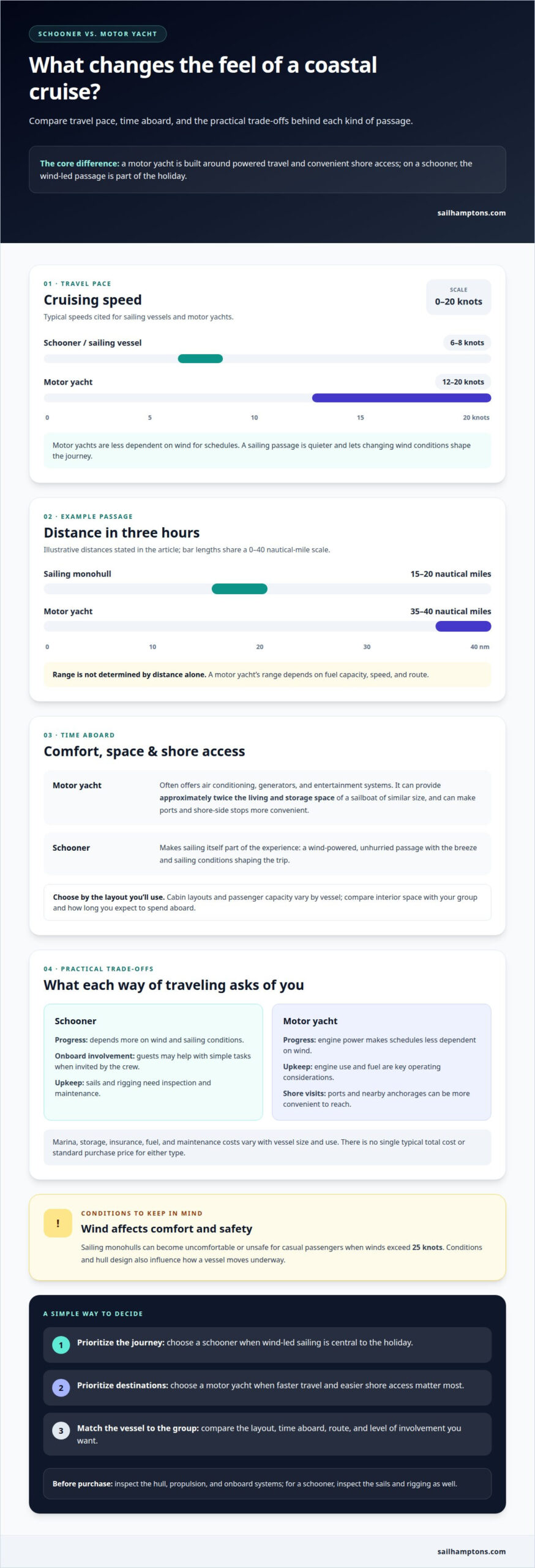
For port calls and shore-side stops, motor yachts can be more convenient than sailing vessels, and engine power makes schedules less dependent on wind. Sailing offers a quieter, wind-powered passage. The better fit depends on whether you prioritize reaching destinations or enjoying the journey.
Motor yachts commonly cruise at 12-20 knots, compared with 6-8 knots for sailing vessels. On a three-hour trip, a motor yacht may cover 35-40 nautical miles, while a sailing monohull may cover 15-20. A motor yacht’s range depends on its fuel capacity, speed, and route, so distance alone doesn’t determine how far it can travel.
Onboard features shape comfort, too. Motor yachts often have air conditioning, generators, and entertainment systems. A motor yacht can offer approximately twice the living and storage space of a sailboat of similar size. Cabin layouts and passenger capacity vary by vessel, so match the interior to your group and the time you expect to spend aboard.
Marina, storage, insurance, fuel, and maintenance costs vary with the vessel and how it’s used. Larger boats can have higher fuel consumption and marina fees. Sailboats also need sail maintenance, while motor yachts rely more on engine use. Neither type has one typical total cost; size, upkeep, and operating patterns shape the difference.
There’s no supported standard purchase price for either type. Purchase cost depends on the vessel’s size, condition, equipment, and design, so compare specific boats rather than assuming schooners or motor yachts always cost more.
Each vessel has different operating considerations. Sailing monohulls can become uncomfortable or unsafe for casual passengers when winds exceed 25 knots. Motor yachts depend on engines, while schooners rely on sails and wind. Before purchase, inspect the hull, propulsion, onboard systems, and, for a schooner, sails and rigging.
| Option | Typical cruising speed | Comfort and use | Key consideration |
|---|---|---|---|
| Schooner | 6-8 knots for sailing vessels | Wind-led passage | Wind shapes progress |
| Motor yacht | 12-20 knots | More living and storage space | Fuel and engine upkeep |
| Speedboat | Varies by vessel | Quick outings and watersports | Less suited to spacious cruising |
Choose a motor yacht for faster passages, shore access, and powered amenities; choose a schooner when sailing itself is central to the holiday.
Boat Holiday Alternatives: Sailboat or Motor Yacht?
Start with your sailing goals: decide whether you want a wind-led journey or an engine-powered passage, and how much you want the route and pace to depend on sailing conditions. That choice shapes the kind of outing that suits your holiday.
Wind-Powered Sailing Yachts
A sailing yacht uses sails to harness the wind, making changing conditions part of the experience. Guests can enjoy the shifting breeze and help with simple onboard tasks when the crew invites them, while the crew manages navigation and sail handling. Sailing monohulls are faster and more responsive to sail trim upwind than catamarans. Longer routes may involve additional stops for fuel and supplies.
Sailing Yachts and Sailboats
“Sailboat” describes a vessel propelled primarily by sails; “sailing yacht” often emphasizes a leisure craft intended for a more considered onboard experience. The terms overlap, so neither label alone tells you the layout, comfort, or sailing performance. For example, a monohull and a catamaran are both sailing vessels, yet their space and handling differ. Choose by design and itinerary, not name alone.
Operating Skills and Crew Needs
Handling a sailing vessel involves reading wind, adjusting sails, and maneuvering under sail or engine power. A motor yacht relies on propulsion rather than sail trim, but larger boats still demand skill when handling and maneuvering in a harbor. For a holiday charter, the crew can manage the vessel while guests enjoy the passage; active participation depends on the trip and the crew’s guidance.
For choosing between a schooner and a motor yacht, match the boat to your priorities: a wind-powered passage, crew-led comfort, or a route focused on reaching destinations efficiently. If you’re new to sailing, start with a smaller vessel before considering larger boats that require greater handling skill. The right choice makes the journey itself part of the holiday.
Motor yacht comfort and suitability for extended cruising
For powerboat cruises of indefinite length, a yacht suits travelers who place comfort first. That doesn’t make every motor yacht perfect for every itinerary. Cruising plans, onboard space, and the conditions along the route all shape how comfortable time aboard feels.
Consider how you’ll use the interior during a longer journey. A spacious salon gives guests room to gather, while cabins provide private places to rest between stops. Storage also matters: luggage, provisions, and personal belongings need to fit without crowding the living areas. Compare the layout with your group’s daily routines, not just the vessel’s appearance.
Stability affects comfort underway, but vessel type alone doesn’t promise a smooth ride. Sailing vessels sit deeper in the water because of their center of gravity, and are described as more balanced than motor yachts. Conditions and hull design also influence motion. For a relaxed holiday, the question is whether guests prefer a powered passage or the changing pace of a sailing route.
Extended cruising adds practical demands. Fuel use, engine upkeep, provisions, and access to supplies become relevant as the route lengthens. Motor yachts travel under engine power, while sailing vessels can rely on wind and may use their engines less frequently. Those differences can influence trip planning and maintenance needs, but don’t establish one universal range or cost.
For an ocean crossing, YATCO recommends a vessel at least 35-40 feet long for a safer and more comfortable passage. That guidance is about length, not a guarantee of comfort or suitability. A larger vessel also requires greater skill to handle and maneuver in harbor, so account for crew capability alongside onboard features.
Use these factors to assess liveaboard comfort:
- Match cabin and salon space to the number of travelers.
- Plan storage around luggage and provisions for the route.
- Balance desired comfort with cruising distance, fuel needs, and stops.
A motor yacht may be the better fit for comfort-led, extended power cruising; compare its layout and operating demands with your actual itinerary before deciding.
Choosing a yacht based on travel preferences
Build your decision around the holiday you want, not a vessel’s image. List your priorities: time underway, time ashore, preferred destinations, and whether sailing itself is part of the thrill.
If you want to visit several islands or cover more distance in a limited charter, an engine-powered yacht can make a faster itinerary practical. Motor yachts commonly cruise at 12-20 knots, while sailing vessels cruise at 6-8 knots. That difference affects how much of your day goes toward passage versus time at each destination.
Prefer a slower rhythm? A schooner makes wind and sail handling part of the experience. Its route and pace depend more on sailing conditions, so the pleasure is less about reaching each stop quickly and more about the open-water passage. Sailing vessels can travel long distances, but may need more stops for fuel and supplies.
Consider how involved you want to be. A crew-led motor yacht holiday suits guests who want to focus on conversation, scenery, and shore visits. A sailing trip can appeal if you enjoy watching the crew trim sails and respond to changing wind. Neither choice requires every guest to operate the vessel; the right fit depends on the role you want during the voyage.
Use this quick decision guide:
- Choose a schooner if you prefer wind-powered cruising and the passage is a highlight.
- Choose a motor yacht if you value speed, efficient travel, and frequent stops ashore.
- Shape the itinerary first if distance, island visits, and time at each stop matter equally.
Before booking a charter, sketch a typical day: departure, time underway, a shore visit, and the return. If the route matters more than the sailing sensation, favor an engine-powered vessel. If the sensation is the point, let the wind lead. Plan a yacht holiday around your preferred pace.
SailHamptons
SailHamptons helps turn your preferred pace and style of time on the water into a tailored charter. If you’re drawn to a traditional sailing experience, Luna Private Charter features a large Bermudian schooner; for a classic motor-yacht setting, Blue Sky Private Charter offers a lobster yacht. Cosmos Private Charter adds another distinct option with its mahogany performance trimaran, while the Public Sunset Sail suits guests looking to enjoy an evening passage.
Share the kind of day you envision, from a leisurely sail to a more performance-minded outing, and choose the charter that best fits your plans. The right vessel makes the journey feel as memorable as the destination. Contact SailHamptons to discuss your holiday on the water.
Let Your Holiday Set the Course
The best choice is the vessel that makes the day feel like yours. Before planning, picture one moment you’d most like to remember: a quiet stretch under sail, an easy arrival ashore, or time shared on deck as the coastline slips by. That image can guide the pace and character of your outing.
Choosing between a schooner and a motor yacht becomes less about selecting a category and more about shaping an experience around your guests. Consider how you want to spend time aboard, what kind of passage will feel enjoyable, and which details would make the occasion personal. A thoughtful plan leaves room for the scenery, the company, and the pleasure of being on the water.
Start planning your yacht holiday with SailHamptons, and take the first step toward a day on the water that feels distinctly yours.
Frequently Asked Questions
Are Sailboats More Comfortable for a Yacht Vacation?
Not necessarily; comfort depends on what you enjoy during a holiday and how the vessel suits your group. A sailboat can feel especially rewarding if you like being close to the sailing experience and don’t mind a slower pace. For a group that values a more spacious interior or a schedule built around shore stops, a motor yacht may feel like a better match.
Do Yachts Have Sails?
Yes, some yachts have sails, while others are powered by engines. “Yacht” describes a recreational vessel, not one specific propulsion system. A schooner is a sailing vessel, while a motor yacht relies on engines. The word “yacht” alone doesn’t tell you how an outing will travel.
What Is the Difference Between a Schooner and a Motor Yacht?
A schooner is a sailing vessel, while a motor yacht travels under engine power. That distinction changes the character of the passage: on a schooner, wind and sail shape the journey; a motor yacht offers engine-powered travel. For a Sag Harbor outing, consider whether your group wants the sailing itself to be central or prefers a trip planned around powered cruising.
Which Type Is Better for Coastal Cruising, Offshore Trips, or Day Use?
For coastal cruising with frequent shore visits, a motor yacht can suit an itinerary focused on reaching stops efficiently. A schooner may suit a day outing where the sail across the water is part of the occasion. Offshore trips call for a vessel and plan suited to the route and conditions, not simply a choice between sails and engines. Match the boat to the journey.
How do marina, storage, and insurance costs compare?
Marina, storage, and insurance costs vary with the vessel and how it is used; larger boats can have higher marina fees. Compare specific boats rather than assuming one type always costs more.
What are the typical fuel and maintenance costs for each?
There is no single typical cost: fuel and maintenance depend on the vessel, its upkeep, and how it is used. Motor yachts rely more on engine use, while sailboats need sail maintenance and may use their engines less frequently.