
A memorable private charter depends on more than the yacht: the crew’s roles shape the comfort, pace, and feel of the day. Understanding the role of the crew on a private charter starts with a practical point: you can request an onboard attendant, while the crew assigned and their duties depend on the yacht and charter. A request helps set expectations, but it doesn’t determine the final crew arrangement.
It’s natural to want to know who will be at the helm, who will look after guests, and where to direct a request once you’re aboard. Knowing how those responsibilities fit together makes it easier to share your preferences and enjoy your time on the water in Sag Harbor.
This guide explains common crew roles, what to consider when assessing qualifications, and how to discuss an attendant request. It also covers gratuities, including how to approach tipping and what to understand about its distribution. With the practical details in hand, you can settle into the voyage with greater confidence and leave room for the coastal scenery to take centre stage.
Key Takeaways
- Understand why the captain has final authority over safety and itinerary decisions, and how to respond when plans change.
- Learn which qualifications and experience can help you assess a crew’s readiness and professionalism.
- Find out when you can request an attendant and how yacht size and charter type shape onboard service.
- Get a clearer sense of how charter gratuities work and what to consider when deciding how to tip.
Respecting the captain’s safety decisions
On a U.S. private charter, follow the captain’s safety instructions and itinerary decisions. The captain has final authority and overall responsibility for the yacht, guests, safety, logistics, and crew management. Crew hours and passenger limits relate to the vessel and its operation, while the captain’s immediate direction governs onboard safety.
Weather can change the day’s route. A captain adjusts an itinerary when conditions could affect people’s safety or comfort, even if the original plan included a particular destination. Treat a revised course as a professional decision, not a negotiation. Guests can share preferences, but the captain makes decisions about the yacht and itinerary. For example, if weather makes a planned anchorage unsuitable, the captain may choose a more comfortable route.
Safety training is part of crew readiness. STCW’2010 is a safety qualification commonly expected by yacht captains, though the certification and training requirements for cabin crew depend on the specific U.S. charter. Navigation expertise also matters: the captain manages the yacht’s route and responds to conditions, while each crew member supports safe, attentive hospitality within their role.
| Role or training | Safety focus | Guest expectation |
|---|---|---|
| Yacht captain | Navigation, safety, logistics, itinerary | Follow directions and accept weather-led changes |
| Yacht crew member | Role-specific safety support | Receive clear guidance during the charter |
| Private jet flight attendant | First aid, fire control, aircraft evacuation, emergency procedures | Training applies to aircraft, not yacht crew duties |
Choose your expectations by distinguishing the setting: STCW’2010 concerns yacht safety qualifications, while aircraft attendants train for aviation emergencies. Don’t treat one credential as proof of every skill.
For a smoother charter, listen to the captain’s briefing, follow instructions promptly, and share comfort or access needs calmly. Safety decisions take priority, providing the foundation for thoughtful hospitality and a memorable voyage.
Crew qualifications and experience
A yacht crew’s experience matters most when it fits the member’s assigned role. The captain handles navigation and command, while guest-facing crew focus on service and hospitality. Consider qualifications in context: experience should relate to the work performed aboard, rather than simply signal general experience on yachts.
Charter crews welcome new guests on each trip, often delivering customized service before learning individual preferences. That calls for attentive listening and quick adaptation. A guest who prefers a quiet morning, for example, can share that before departure, then offer feedback during the voyage around Sag Harbor. The crew can use those details to shape the guest experience throughout the trip.
Before travel, share interests, preferences, and dislikes through the pre-charter preference sheet. During the charter, continue communicating requests and feedback so the crew can tailor the experience. Before disembarking, direct any final onboard question to the captain or Chief Stew. This gives the crew a chance to address practical matters while you’re still aboard.
For onboard requests, speak with the captain or a crew member handling guest service. They can direct the request to the appropriate person, whether it concerns service timing or a change in plans. This clear route helps prevent conflicting instructions and keeps guest requests coordinated. Treat crew-only spaces as work areas, and avoid interrupting crew there.
To assess a crew’s experience, consider these practical points:
- Role fit: Match the crew member’s stated experience and training to their onboard responsibilities.
- Guest service: Look for examples of adapting hospitality to new guests and their preferences.
- Communication: Notice whether the captain or Chief Stew provides a clear route for requests.
Charter work is service-intensive, and yacht crew have limited downtime while guests are aboard. Polite, specific communication supports a smoother voyage and helps set expectations for personalized hospitality.
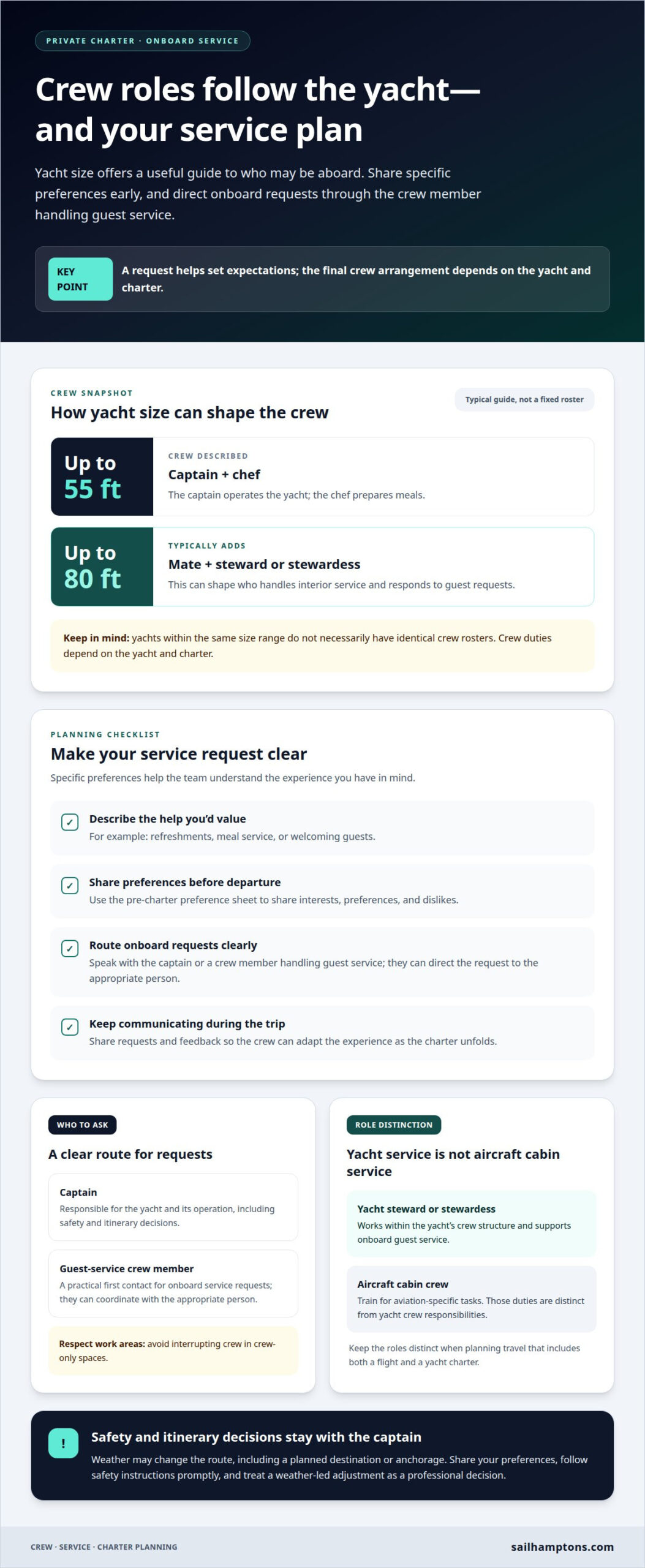
Whether attendants are required on every charter
Crew roles are organized around the yacht and charter plan. SailHamptons provides professional, hospitality-focused crews, with the captain retaining control of the vessel and its operation. Share your service preferences before the charter so the crew can take them into account when planning the onboard experience.
The yacht’s size offers one useful guide. Yachts up to 55 feet are described as having a captain and chef; yachts up to 80 feet typically add a mate and a steward or stewardess. That difference can shape who handles interior service, prepares meals, and responds to guest requests. It doesn’t mean every yacht within a size range has an identical crew roster.
Make requests specific. For example, explain whether you’re hoping for help with refreshments, meal service, or welcoming guests. That gives the team a clearer picture of the experience you want, rather than leaving the request open to interpretation. You can also share preferences when planning your charter, then direct onboard requests to the captain or crew member responsible for guest service.
An onboard yacht crew member is not the same as a flight attendant. A yacht steward or stewardess works within the yacht’s crew structure; aircraft cabin crew train for aviation-specific tasks. Keeping those roles distinct helps set practical expectations when planning travel that involves both a flight and a yacht charter.
Before departure, consider these points:
- Service needs: Describe the type of onboard assistance you’d value.
- Interior arrangements: Explain how you expect guests to use shared spaces.
- Communication: Share preferences before travel and route requests to the Captain or Chief Stew aboard.
Clear expectations help the crew shape hospitality around your group and destination. Describe the service you want while recognizing that crew responsibilities are organized around the yacht and its charter plan.
How does crew size and service vary by yacht size and charter type?
Yacht length offers a useful starting point for understanding crew scale. A yacht up to 100 feet typically has a crew of 4 to 6 people, while a yacht over 150 feet may carry more than 10. On larger yachts, teams can reach 30 or more crew members. More people allow responsibilities to be divided across navigation, food, and guest service. Understanding the role of the crew on a private charter also means considering how those responsibilities fit the vessel.
The yacht and charter plan shape how hospitality is delivered. A compact crew may handle several parts of the experience, while a larger crew can divide responsibilities across different areas. Crew numbers alone don’t describe the full experience: the yacht’s layout, planned activities, and your group’s preferences also shape how service unfolds.
Charter type matters, too. A corporate gathering may call for a different pace and guest flow than a wedding celebration or a relaxed family outing. The crew’s service is organized around the charter’s purpose, itinerary, and requests shared in advance. A clear preference sheet helps the team prepare for details such as meal timing, onboard activities, and the atmosphere you want. Understanding the role of the crew on a private charter can help you describe those priorities clearly.
| Yacht size | Typical crew scale | What it can mean for service |
|---|---|---|
| Up to 100 feet | 4 to 6 crew | A compact team handles the voyage and guest needs |
| Over 150 feet | More than 10 crew | Responsibilities can be more specialized |
| Larger yachts | 30 or more crew members | Teams may cover distinct service areas |
Use yacht size as a guide, then match the service plan to your event, guest preferences, and itinerary. For a gathering where timing and hospitality matter, share the occasion and priorities as part of your charter planning. You can explore private charter options for an outing shaped around your group.
SailHamptons
SailHamptons offers private charters with professional, hospitality-focused crews, giving you a place to begin planning the experience around your group. Choose among Luna Private Charter, Cosmos Private Charter, and Blue Sky Private Charter, or consider the Public Sunset Sail for a shared evening on the water.
As you shape your plans in Sag Harbor, consider the kind of outing you want, the atmosphere you prefer, and any guest preferences you’d like to share ahead of time. Those details help frame your expectations for onboard service and give the crew useful context for welcoming your group. Whether you’re planning a quiet sail or a gathering with friends, the right charter starts with a clear sense of what matters to you.
For help considering your charter plans, contact SailHamptons.
Set the course for your charter
Understanding the role of the crew on a private charter can help you shape an outing that feels natural from the first welcome to the final moments aboard. As you plan, think about the atmosphere you want, the moments you hope to share, and the preferences that would make your time on the water feel personal. Clear details give the crew a thoughtful starting point for guest-focused hospitality.
SailHamptons offers Luna Private Charter, Cosmos Private Charter, and Public Sunset Sail. Consider which kind of experience best suits your plans, whether you’re drawn to a private voyage or a shared sunset sail. The choice is yours; the coastline sets a beautiful scene either way.
When you’re ready to shape your plans, contact SailHamptons about your charter. Share the occasion and the experience you have in mind, then look forward to a day guided by the rhythm of the water.
Frequently Asked Questions
Can I request an attendant if one is not included?
Yes, you can request an attendant before your Sag Harbor charter. Share the kind of assistance you have in mind, such as help with serving refreshments or welcoming guests, so the request is clear. An attendant request helps shape service expectations, but it doesn’t automatically change the crew plan. The yacht’s setup and assigned crew roles determine how onboard service is organized.
Onboard Etiquette: What Are The Unspoken Rules?
Be considerate of the crew’s working environment and follow their instructions around the yacht. For example, ask before handling unfamiliar equipment, keep bags out of passageways, and wait for guidance before moving through an area where crew are working. If you’re unsure about an onboard custom, a polite question is welcome. These small courtesies help everyone move comfortably through the charter.
The Role Of The Crew: Who’s Who?
The captain leads the vessel, while other crew members support deck operations, food service, or guest hospitality according to their roles. For example, a crew member may focus on preparing a planned meal while another supports service in guest areas. Titles and assignments vary between yachts, so a brief introduction at boarding can help you direct questions appropriately.
What are the typical roles and responsibilities of crew on a private yacht charter?
The crew works together to operate the yacht and deliver the planned guest experience. The captain oversees navigation and onboard decisions; other members may assist with sailing, meal preparation, or hospitality. For instance, a change to the meal schedule is a service request, while a question about the route belongs with the captain. The crew’s exact duties depend on the vessel and charter plan.
How many crew members are usually included on a private charter?
There isn’t one fixed crew count for every charter; yacht size is a useful guide. A yacht up to 55 feet is described as having a captain and chef, while a yacht up to 80 feet typically adds a mate and steward or stewardess. Larger vessels can carry larger teams. The charter’s needs and the yacht’s arrangement also shape the crew roster.
What qualifications and licenses are required for private charter crew in the United States?
Requirements depend on the crew member’s role and the charter operation; one credential doesn’t apply to every onboard position. STCW’2010 is a safety qualification commonly expected by yacht captains, but that does not make it a universal legal requirement for every crew member. For example, a captain’s navigation responsibilities differ from a steward’s guest-service duties, so assess qualifications against the actual role.