The Hamptons’ screen-famous shoreline is more than a backdrop. A filming location on the water in the Hamptons can mean the Napeague beach house used in Summer House Season 1, the show’s Water Mill setting from Season 2, or Dune Beach, where Carl proposed to Lindsay. Nearby Montauk also features prominently in The Affair, which was set there.
It’s easy to assume every familiar coastal scene was filmed at the exact spot shown on screen, but productions often use different locations for homes, beaches, and outdoor shots. Knowing which Hamptons locations are real, where they are, and whether they’re private can help you plan a more rewarding visit.
This guide explores the Hamptons and nearby towns connected to film and television, from beaches and harbors to memorable estates and streetscapes. It also distinguishes private properties from public places, so you can enjoy the scenery with more context and a clearer sense of direction.
Key Takeaways
- Distinguish a location featured on screen from a public place you can visit; waterfront homes and filming properties may be private.
- Look beyond the beach: nearby towns and inland settings can provide context for the Hamptons scenes you recognize.
- Plan filming around local rules, since some towns may apply stricter restrictions or refuse permits from May through Labor Day.
- For a private sailing experience on the water, consider SailHamptons’ Luna Private Charter as a different way to enjoy the coastal setting.
4. Which Hamptons beaches, bays, marinas, and waterfront properties allow filming?
A screen appearance doesn’t mean a location is open for filming today. In the Hamptons, recognizable settings range from public-facing beaches to private homes, each with different access considerations. Treat a filming location and a place available to a production as separate things. You may be able to see a shoreline or nearby streets, while filming requires permission for the specific site.
Summer House offers a clear example. Season 1 was filmed at a beach house on Napeague, near Amagansett. Starting with Season 2, the show moved to Water Mill, within the Town of Southampton. Its current filming house is between Sag Harbor and Water Mill, but it is a private rental property and isn’t open to the public. Seeing the area doesn’t provide access to the house.
The distinction matters around bays and marinas, too. A waterfront view can help you recognize a setting without being a site available for filming. The examples below identify properties, beaches, and places that have appeared on screen; they don’t indicate that those locations are open to new productions. Use them to understand the region’s screen geography, not as a list of places where you can film.
For a cinematic beach setting, Dune Beach in Southampton is linked to Summer House: Carl proposed to Lindsay there during the summer of 2022. It is a recognizable real-world point of interest, but that fact alone doesn’t establish filming permission. Keep the distinction clear: a beach can be associated with a scene, while a production’s ability to film there remains a separate matter.
Beach Lane offers a different kind of waterfront reference. The modern estate at its end was selected for Adrien Brody’s character in Succession. The series finale aired in 2023 and included outdoor shots filmed in the Hamptons. These details help identify the coastal look behind the scenes, but the estate is a property, not a public filming venue. A location scout should separate the landscape from the address and its access.
Something’s Gotta Give adds another famous Hamptons home to the conversation. Its sale underscores a practical point for anyone searching for waterfront properties: a home’s appearance in a movie doesn’t make it open to visitors or available for filming. Treat private residences as private locations.
For a quieter, less mansion-focused reference, look to Springs. Pollack, released in 2000, was shot predominantly at Jackson Pollock’s former residence there. The film also includes the Southampton railroad station, the old Miller Store, and Springs Fireplace Road. These examples show how a production can draw from several types of location, rather than relying on one waterfront property or beach.
Montauk broadens the search beyond the central Hamptons. The Affair ran from 2014 to 2019, was set in Montauk, and used many on-location shots there. No Hard Feelings, released in 2022, is set entirely in Montauk and includes the actual Saldivar’s Clam & Chowder House, although most shots of the parents’ house were filmed in Nassau County. For any waterfront scene, identify the exact setting first, then distinguish the place shown from a location available for filming.
The examples in this section don’t establish that any named waterfront location is available for new productions. They identify places associated with filming or screen appearances, but access depends on the site and the permissions required.
No specific beach, bay, marina, or waterfront property is confirmed as open to new productions. Filming permission depends on the site and the required approvals; a screen appearance alone doesn’t establish availability.
3. What are the rules for filming on Hamptons beaches, docks, and waterways?
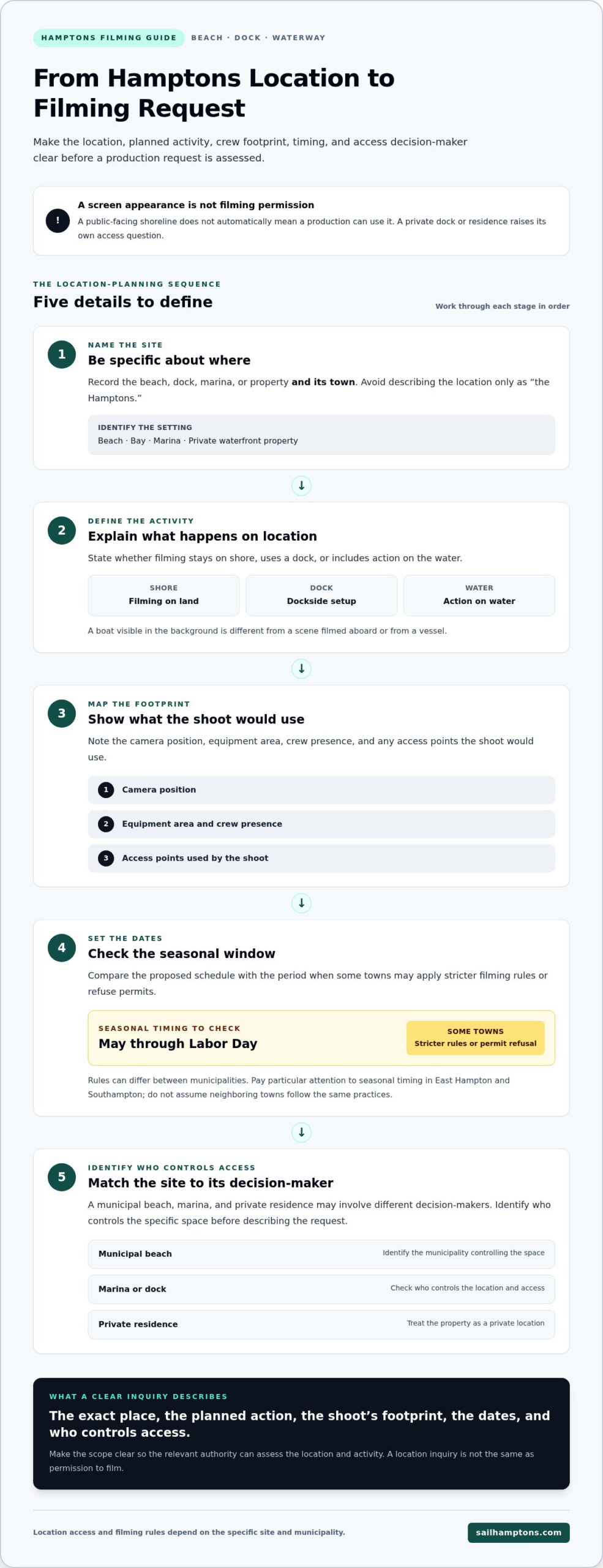
Start with the town, not the camera setup. Filming rules can differ between Hamptons municipalities, and some towns may impose stricter rules or refuse permits for shoots from May through Labor Day. That seasonal window matters for beach scenes, dockside setups, and camera work involving the water. Plan around the specific town and dates before deciding where the production will operate.
A beach, bay, marina, and private waterfront parcel are different settings to assess. A public-facing shoreline doesn’t automatically mean a production can use it, while a private dock raises a separate access question. Identify the exact filming area, including where the crew, equipment, and vehicles would be positioned. Then determine which municipality or property manager controls that space.
Use this sequence to make your location request more precise:
- Name the site. Record the beach, dock, marina, or property and its town, rather than describing it only as “the Hamptons.”
- Define the activity. Describe whether filming stays on shore, uses a dock, or includes action on the water.
- Map the footprint. Note the camera position, equipment area, crew presence, and any access points the shoot would use.
- Set the dates. Compare the proposed schedule with the May-through-Labor-Day period, when some towns may apply stricter rules or refuse permits.
- Identify who controls access. A municipal beach, marina, and private residence may involve different decision-makers.
This outline helps distinguish a location inquiry from a request to film. A scene framed from a public beach may affect a different area than a production placing equipment on a private dock. A boat visible in the background is also different from a scene filmed aboard or from a vessel. Describe the planned action clearly so the relevant authority can assess the location and scope.
Pay particular attention to seasonal timing in East Hampton and Southampton. A planned summer shoot may fall within the May-through-Labor-Day period, when some Hamptons towns may impose stricter filming rules or refuse permits. Don’t assume neighboring towns follow the same practices. If a location crosses a town boundary, identify which parts of the shoot fall within each municipality.
Waterfront scenes require careful site planning beyond the shoreline. A camera position on land, a setup on a dock, and filming from a boat each involve a different area. List every place the production expects to use and align the proposed activity with that description. This helps distinguish a scenic view from a usable filming site.
Famous screen locations show why access and filming permission are separate issues. The Summer House home in Water Mill is a private rental property, while Dune Beach in Southampton is associated with a scene from the show. Neither connection establishes permission for a new production. Treat these examples as location context, not approval to film.
For a location scout, the practical takeaway is simple: name the town, define the precise waterfront area, describe the activity, and account for seasonal timing. A filming location on the water in the Hamptons becomes easier to assess once “waterfront” is replaced with a specific beach, dock, marina, or property. If your aim is to enjoy the coast rather than organize a shoot, consider a peaceful on-water outing.
The relevant municipality and the property manager who controls the site determine access and filming permission. The decision-maker may differ for a municipal beach, marina, or private waterfront property.
Property descriptions can help keep a location request specific without implying that a nearby beach, marina, or home is the filming site. The Surf-Chic Gem in East Hampton’s Clearwater Private Beach & Marina Association is a 2,800-square-foot home. The Luminous Open-Concept and Modern Serene Luxury retreat in Amagansett is a mile from the main beaches. Those details distinguish a residence from shoreline activity; they do not, by themselves, describe where cameras or crew would be placed.
Visual references also need a precise location check. A Vanity Fair cover featuring Scarlett Johansson was published in June 2025 and showed her in beach and house scenes with a Hamptons look, although the house and beach were in Nassau County. A Hamptons look is not proof that filming took place in the Hamptons. For a location request, describe the actual beach, dock, water, or home involved, and clarify whether the scene stays on shore, uses a dock, or takes place from a vessel. That keeps the location and activity clear for the authority reviewing access.
SailHamptons: Luna Private Charter
SailHamptons offers the Luna Private Charter for guests who want to experience the Hamptons from the water, rather than arrange a production shoot at a shoreline location. Aboard the large Bermudian schooner, you can take in the coast from a new perspective, with open water and waterfront scenery as the setting for your outing.
For another private-boat experience, consider Cosmos Private Charter aboard a mahogany performance trimaran, or Blue Sky Private Charter on a classic lobster yacht. The Public Sunset Sail offers a shared way to take in the coast as evening light settles over the water. Each is an experience on the water, not filming access to private properties or beaches.
For a tailored coastal outing, contact SailHamptons.
Let the Coast Inspire Your Next Outing
A familiar shoreline can spark a different kind of adventure: seeing the Hamptons from the water, where changing light and an open horizon bring the coast into view anew. If a filming location on the water in the Hamptons has caught your imagination, let that curiosity inspire a day enjoying the scenery, rather than trying to reproduce a scene or access private property. For travelers whose appreciation for dramatic landscapes extends beyond local shorelines to global travel, Steve & Richard Safaris organizes guided tours and holiday packages across renowned African destinations.
SailHamptons offers the Luna Private Charter and Cosmos Private Charter for private outings, as well as the Public Sunset Sail for an evening on the water. Each offers a distinct way to enjoy the coastline at an unhurried pace. Choose the experience that suits your plans, whether you prefer a private charter or a shared sunset sail.
Contact SailHamptons to plan your visit, and make the coast part of a memorable day.
Frequently Asked Questions
What movies and TV shows were filmed on the water in the Hamptons?
Some productions filmed waterfront scenes locally, while others only used the Hamptons as a setting. The 1988 thriller Masquerade used locations from East Hampton to Shelter Island, including Montauk Harbor for a yacht explosion. JAWS is a notable exception: although its story is connected to the Hamptons, the 1975 film was shot entirely on Martha’s Vineyard. For a Sag Harbor-area outing, distinguish actual filming sites from fictional settings.
Can production boats film in Peconic Bay, Shinnecock Bay, and the surrounding waters?
Permission depends on the specific waters, municipality, and activity. Identify where the boat would film and whether filming would take place aboard or from the vessel, then contact the authority that controls access.